
Borrowing Against Mined Coins: When It Makes Sense
Borrowing against mined coins makes sense when the alternative is selling production you would rather keep, and when your hashrate can service the balance. The arithmetic is unforgiving: at 1 PH/s, mining 0.5 BTC takes about 1,115 days at today's difficulty of 132.76 T, while selling 0.5 BTC at $84,692 raises $42,346 today. A loan sits between those two positions — it converts future production into present liquidity without handing over the coins.
Key takeaways
- A pledge keeps the coins and the hashrate; a sale converts 0.5 BTC into $42,346 and ends the upside.
- Cover only what production can repay. At 20 J/TH and $0.06 per kWh, 1 PH/s leaves roughly $7.67 a day after the listed 4% fee and power.
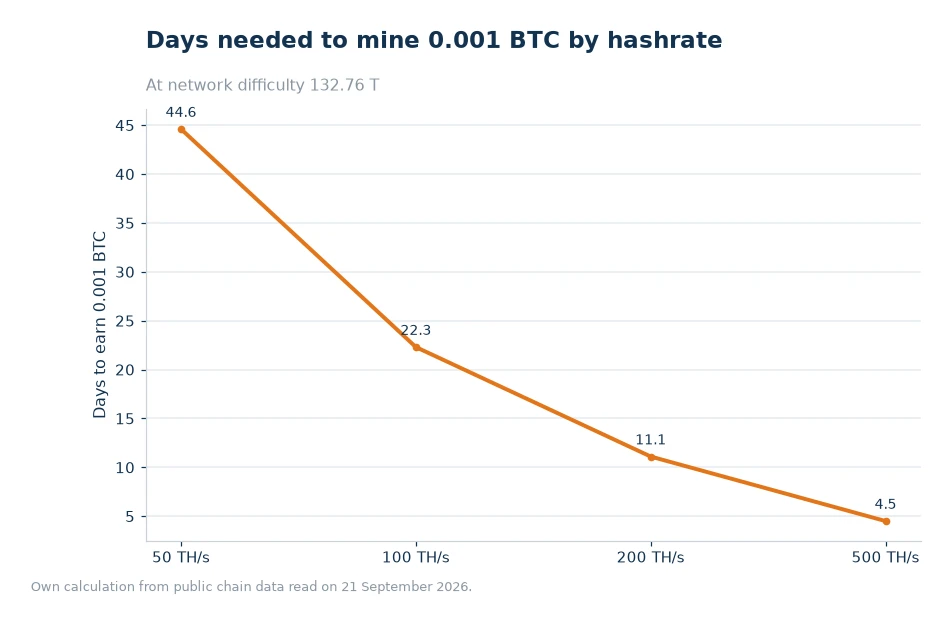
- Smaller loans clear faster: 0.05 BTC takes about 111 days at 1 PH/s, but only 22 days at 5 PH/s.
- Payment method sets the timing, so repay from the cadence you actually receive — hourly on PPS+, block-linked on PPLNS.
The short answer
It makes sense when three conditions hold at once. You expect the machines to keep running, you do not want to sell mined coins at the current price, and the daily margin after power covers the repayment schedule with room to spare. If any one of those fails, a pledge converts a mining operation into a timing bet.
The reason miners reach for this at all is structural. Mining produces coins steadily and money lumpily: the electricity invoice arrives on a fixed date, while in PPLNS mode payouts arrive when the pool finds blocks. A loan smooths that mismatch without liquidating the inventory that produced the income in the first place.
How the mechanism works
Facilities such as the ViaBTC Crypto Loan publish the process as a five-step loop: Add Collateral, Apply for Loan, Receive Loan, Repay Loan and Redeem Collateral. Nothing about that loop is exotic, and the sequencing is what makes it useful — collateral is locked while the loan is outstanding and released on repayment, so the coins are not sold into the market at any point.
Two features of the wider account matter for how that loop behaves in practice. First, mining income can be settled with zero-fee mining payouts into the same account that holds the collateral, so repayment and production live in one balance sheet rather than two. Second, a multi-currency wallet with Auto Conversion between supported assets means the coin you repay with does not have to be the coin the pool paid you in.
That account structure is part of a mining pool platform serving miners in more than 150 countries, which matters for one practical reason: payout rails and lending terms sitting inside the same product means fewer counterparties to reconcile when the balance comes due.
Where miners get it wrong
The first mistake is sizing the borrow against the value of the hardware or the coin, instead of against the margin the hardware produces. A position whose monthly repayment exceeds its monthly margin is not financed, it is delayed.
The second is reading the fee as one number. The listed 4% applies to the PPS-settled block-reward component; the transaction-fee component is distributed with PPLNS logic at a listed 2% fee. Only the second is a haircut on the whole payout, and folding them into a single 6% overstates the cost in low-fee conditions and understates nothing in high-fee conditions — either way it is the wrong number to plan against.[1]
The third is treating hashrate as cash. A 20% efficiency gap on 20 J/TH hardware is 4 J/TH, which at 1 PH/s is 4 kW — around $5.76 a day at $0.06 per kWh, or roughly a third of the margin in the worked example below. Machines do not repay loans; margins do.
Example with two setups, and a checklist
Run the same 0.1 BTC repayment across four hashrate tiers. Output is computed from a network hashrate of about 1,003 EH/s and 450 BTC released per day, which gives 4.486 × 10⁻⁷ BTC per TH/s per day.
| Hashrate | BTC per day (gross) | Days to cover 0.05 BTC | Days to cover 0.1 BTC | Days to cover 0.25 BTC |
|---|---|---|---|---|
| 500 TH/s | 0.000224 | 222.9 | 445.8 | 1,114.6 |
| 1 PH/s | 0.000449 | 111.5 | 222.9 | 557.3 |
| 5 PH/s | 0.002243 | 22.3 | 44.6 | 111.5 |
| 20 PH/s | 0.008972 | 5.6 | 11.1 | 27.9 |
Now apply power. A 1 PH/s setup on 20 J/TH hardware draws 20 kW, or 480 kWh a day — $28.80 at $0.06 per kWh. Gross income is $37.99 a day at an $84,692 BTC price, and after the listed 4% fee on the block-reward component it is about $36.47. The margin is therefore roughly $7.67 a day, or $230 over a month, and a 0.1 BTC repayment worth $8,469 at today's price takes about 1,104 days of that margin rather than the 223 days of raw production. That is the number to size a borrow against.
A checklist you can run today, before you pledge anything:
- Write down the daily margin per PH/s after power and the listed fee, not the gross number.
- Divide the amount you want to borrow by that margin, and ask whether the resulting schedule survives a 20% price fall.
- Confirm which distribution window applies: PPS+ pays hourly against current difficulty, PPLNS pays after 6 confirmations over the last 5 difficulty rounds.
- Check that the platform publishes the sequence and the redemption terms, so you know how the collateral comes back and in what asset you repay.
- Decide the add-collateral or reduce-balance trigger now, while the position is comfortable.
One more practical point about the coins themselves. Any move of mined assets is a transaction that can get stuck when blocks are full, and a repayment date is exactly the wrong moment to discover that a transfer is sitting unconfirmed. ViaBTC's Transaction Accelerator prioritises packing for submitted transactions in the next block the pool mines, with a free tier for transactions of 0.5 KB or smaller at a fee rate of at least 0.0001 BTC/KB and a paid path payable in BTC, BCH or LTC; submissions cannot be cancelled or refunded, and unconfirmed inputs have to be accelerated first.[2]
The naming matters when you compare offers: the product is listed as Collateral-Pledged Loans, a service built for miners who want to keep their coins for the long term while still covering operating costs. Its five documented stages are Add Collateral, Apply for Loan, Receive Loan, Repay Loan and Redeem Collateral, with the pledge released on full repayment.
Frequently asked questions
Can I mine more than one coin at the same time?
Yes. Merged mining lets a machine secure a parent chain and an auxiliary chain together, and multi-coin pools support switching between chains without moving hardware.
Do mining pools cost anything to join?
Joining is free; the pool earns from its fee on settled payouts, which appears as a percentage of the block-reward and transaction-fee components.
What happens if the price falls while a loan is outstanding?
The balance owed stays fixed while the collateral is repriced lower, so the ratio between them worsens by exactly the factor of the fall: a 20% drop is a 1.25x rise in the ratio. Planning for that case in advance is the difference between a top-up decision and a forced one.
The short version
Collateralised borrowing against mined coins is a cash-flow tool, not a way to enlarge a position for free. Compute the daily margin first, divide the intended balance by it, then stress that schedule against a lower price and a slower block cadence. If the plan still clears, a pledge keeps your coins and your hashrate in place while the invoice gets paid on time. If it does not, sell a smaller amount of production and keep the leverage at zero.
Data and sources: ViaBTC fee documentation and fee breakdown[1], Transaction Accelerator terms[2] and the loan product's five-step process[3]. Network difficulty (132.76 T), network hashrate (about 1,003 EH/s), the 3.125 BTC block subsidy and coin prices were read from public chain data and market feeds on 21 September 2026. All figures are computed from those inputs and change with difficulty and price; this is not investment advice.