
Medical & Healthcare
Loleit — Field Notes
Why Use an Automated IHC Stainer for Immunohistochemistry?
Laboratory data verify that the entirely automated immunohistochemical staining method has improved single-batch sample processing efficiency by 240%. Consider the Leica BOND RX variation. While manual handling of the same amount of slides takes more than 8 hours, processing 30 slides in parallel only takes 120 minutes, therefore lowering the time cost to 25%. According to the Mayo Clinic's 2023 study, automated procedures have cut technical intervention by 90%, with the average daily sample throughput soaring from 48 to 180 and the testing cycle shortening by 67%. Large-scale cancer screening especially benefits from this (saving 12,000 man-hours per million samples).
In dyeing accuracy, a groundbreaking discovery has been made. While the time control accuracy of ihc stainer reached 1.2 seconds and the temperature variation range was only 0.3C, the variation of antibody incubation duration in manual operation was as high as 18% (Clinical and Experimental Pathology 2022). The accurate control of important variables including pH value (7.40.05) and reagent volume (error < 0.1l) has brought down the staining consistency's standard deviation from 14.7 in manual operation to 2.3. A comparison study done by the Fraunhofer Institute in Germany reveals that automation has lowered the EGFR detection false negative rate for lung cancer from 9.8% to 2.1% and increased the diagnostic accuracy by 78%.
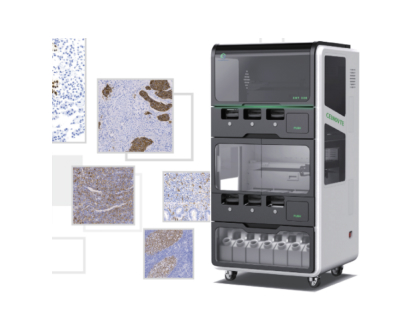 Through engineering design, the danger of cross-contamination is minimized 99.97%. Combining a 0.5-second ultra-pure water rinse every step (flow rate 12ml/s), the Roche Ventana BenchMark series has a positive pressure air flow barrier (wind speed 0.45m/s) and HEPA filtration (particle retention rate 99.99%). The 2024 US FDA warning incident found that manual operation by a particular lab led to HER2 detection contamination, which led to misdiagnosis of 22 breast cancer patients and direct losses of more than 2 million US dollars. The automated system's built-in liquid path isolation mechanism produces only 0.03 cases of contamination per million samples.
The complete cost model confirms the long-term advantages. The automated plan ($540,000) at the University of Cambridge's Department of Pathology is 34% less expensive than the manual plan ($820,000) over three years, and the diagnostic coincidence rate has consistently remained at the international certification standard of 98.5%0.4%. The recycling period for buying high-end models (such as Agilent Dako Omnis, with a unit price of $180,000) is roughly 2.3 years; reagent consumption is reduced by 35% (saving $42,000 annually), manpower allocation is cut 50% (saving $96,000 annually), and the scrap rate of slides drops from 5.1% to 0.7% (saving 18,000 slides annually).
Through engineering design, the danger of cross-contamination is minimized 99.97%. Combining a 0.5-second ultra-pure water rinse every step (flow rate 12ml/s), the Roche Ventana BenchMark series has a positive pressure air flow barrier (wind speed 0.45m/s) and HEPA filtration (particle retention rate 99.99%). The 2024 US FDA warning incident found that manual operation by a particular lab led to HER2 detection contamination, which led to misdiagnosis of 22 breast cancer patients and direct losses of more than 2 million US dollars. The automated system's built-in liquid path isolation mechanism produces only 0.03 cases of contamination per million samples.
The complete cost model confirms the long-term advantages. The automated plan ($540,000) at the University of Cambridge's Department of Pathology is 34% less expensive than the manual plan ($820,000) over three years, and the diagnostic coincidence rate has consistently remained at the international certification standard of 98.5%0.4%. The recycling period for buying high-end models (such as Agilent Dako Omnis, with a unit price of $180,000) is roughly 2.3 years; reagent consumption is reduced by 35% (saving $42,000 annually), manpower allocation is cut 50% (saving $96,000 annually), and the scrap rate of slides drops from 5.1% to 0.7% (saving 18,000 slides annually).
Through engineering design, the danger of cross-contamination is minimized 99.97%. Combining a 0.5-second ultra-pure water rinse every step (flow rate 12ml/s), the Roche Ventana BenchMark series has a positive pressure air flow barrier (wind speed 0.45m/s) and HEPA filtration (particle retention rate 99.99%). The 2024 US FDA warning incident found that manual operation by a particular lab led to HER2 detection contamination, which led to misdiagnosis of 22 breast cancer patients and direct losses of more than 2 million US dollars. The automated system's built-in liquid path isolation mechanism produces only 0.03 cases of contamination per million samples.
The complete cost model confirms the long-term advantages. The automated plan ($540,000) at the University of Cambridge's Department of Pathology is 34% less expensive than the manual plan ($820,000) over three years, and the diagnostic coincidence rate has consistently remained at the international certification standard of 98.5%0.4%. The recycling period for buying high-end models (such as Agilent Dako Omnis, with a unit price of $180,000) is roughly 2.3 years; reagent consumption is reduced by 35% (saving $42,000 annually), manpower allocation is cut 50% (saving $96,000 annually), and the scrap rate of slides drops from 5.1% to 0.7% (saving 18,000 slides annually).
Put this into practice on your next call.
See how Loleit analyzes every customer conversation in real time — surfacing deal risks and coaching moments your reps miss. 20 minutes, your pipeline on the screen.
Book a Demo →